
Danni Unway- The Surf Confidence Coach
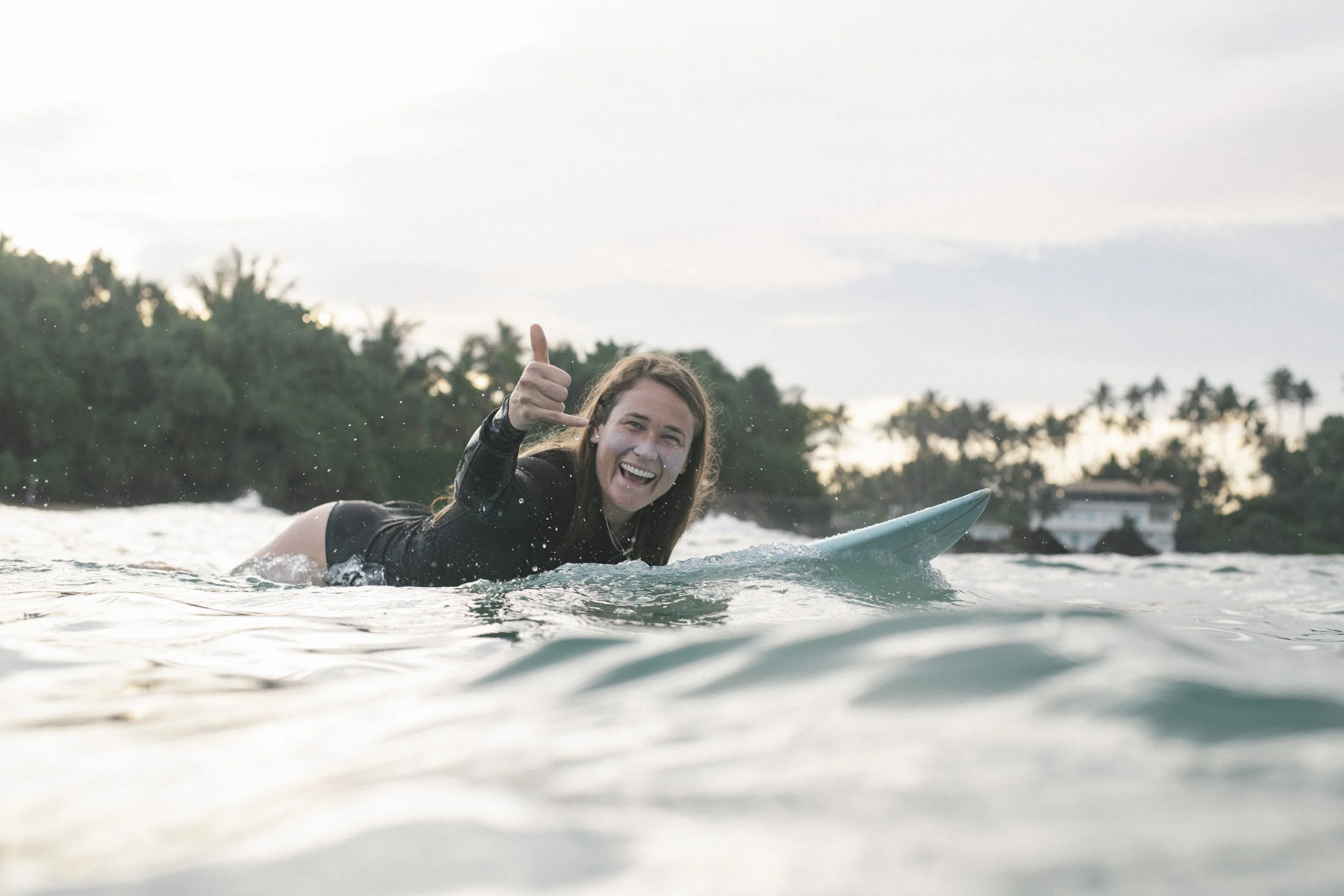
After a twenty-year surf journey, riding my own undulating rollercoaster of fear and confidence, I’ve recently become curious about how surfers experience fear. There is so much wisdom in the water and in many ways surfing can be like holding up a mirror to see our own reflection and it isn't always pretty. Contrary to what the surf films show, it is not all tropical beaches and perfect waves. Human relationships with the sea are nuanced, delicate and beautiful. So I was stoked to get the opportunity to have this very insightful conversation with Danni The Surf Confidence Coach. She will be joining us later this year to host some fascinating confidence workshops - watch this space!
Hey Danni, I’m fascinated by the work you do.Could you tell us a little about your work as a confidence coach and the path that led you there?
I describe my work as empowering surfers to better understand and embrace their emotions in the water by teaching tools and techniques that support increased confidence and emotional safety. I like to think of it as offering surfers of all levels a version of what sports psychologists provide to professional surfers, with one key difference: rather than chasing world titles, the main goal is that you genuinely enjoy surfing.
My path here has been a combination of psychotherapy training, surf coaching and my own rollercoaster relationship with the ocean. I discovered surfing in my early 30s on a surf and yoga retreat and fell head‑over‑heels with it - little did I know it would change my life in ways I couldn’t possibly imagine! On my own surfing journey I went through some rough hold‑downs, lots of confidence dips, plateaus, breakdowns (almost quitting a few times!) as well as many incredible breakthroughs. Over time, I realised how much of what holds us back is mental and emotional, and that there was rarely enough space in traditional surf coaching to talk about fear, anxiety and self‑doubt. I wanted to create a safe space for the emotional side of surfing to be explored and improved and this is how surf confidence coaching was born, bringing my two biggest passions, surfing and human behaviour, together.
Could you talk about the difference between real and perceived fear… in and out of the water?
In simple terms, real fear is your nervous system responding to an immediate, genuine threat, like getting caught inside by a heavy set well beyond your comfort zone, or being in a situation on land that is actually unsafe. Perceived fear is when your mind and body react as if you’re in danger, even when you’re physically safe. For example, you might panic in waist‑high waves because they remind you of a past scary incident. Or you might freeze in a manageable work meeting because it echoes an old experience of being judged. Essentially it’s your nervous system trying to alert you to a possible threat in order to protect you.
In surfing, perceived fear can show up as spiralling thoughts, catastrophising or intense anxiety in conditions that are technically within your skill level, often fuelled by memories, shame or self‑criticism. Out of the water, it might look like overthinking, people‑pleasing or avoiding opportunities because you’re afraid of failing or being seen. This work isn’t about dismissing perceived fear, it’s about learning to recognise it, meet it with curiosity and kindness rather than resistance, and gently retrain your nervous system so it no longer has to shout to get your attention.
What’s the biggest misconception people have about confidence?
One of the biggest misconceptions is that confidence is a fixed trait you either have or you don’t. In reality, it’s a fluid, relational experience that naturally ebbs and flows, just like the tides. People often believe that if they were truly confident, they’d never feel fear, self‑doubt or anxiety, but in my experience true confidence is about accepting those emotions as a natural part of our journey rather than trying to get rid of them. When we practice acceptance, we can move through these emotions and the more difficult stages of our surfing or life more smoothly, rather than getting stuck there.
Another common misconception is that confidence comes purely from nailing moves or ticking off goals as fast as possible. When we get overly attached to a specific outcome or timeline - “I should be surfing X‑size waves by now” - we lose presence, become self‑critical and ironically block the very progression and joy we’re craving. True confidence is more about cultivating emotional safety, self‑trust and willingness to be a beginner again and again, even when it feels uncomfortable.
Can you share a moment where your own confidence was shaken and what helped you rebuild it?
A big rupture point in my own journey was a horrible hold‑down in Bali that really shook my trust in myself and the ocean. What had felt like a romantic honeymoon phase with surfing suddenly became turbulent; I started second-guessing my decisions, hesitating on waves and feeling far more anxious in conditions I’d previously enjoyed.
Rebuilding my confidence took time and looked much more like a spiral than a straight line. I had to strip things back, lower the stakes and focus on rebuilding emotional safety through grounding, breath, positive self‑talk and a lot of self‑compassion. I also reframed the experience as another “phase” in my ongoing relationship with surfing, rather than proof that I wasn’t good enough. Allowing the fear to be there, rather than fighting it, helped me move through it with more ease and eventually find acceptance and even gratitude for what it taught me.
What’s the smallest change someone can make today to start building confidence in the water specifically?
The smallest, most powerful change is to start noticing your inner dialogue in the water and gently shifting it towards a kinder, more encouraging tone. Ask yourself, “What would a kind friend say to me right now?” and actually say those words to yourself when you wobble, fall or hesitate.
Can someone experience fear at any stage of their surf journey?
Absolutely. Fear can arise at every single stage, from catching your first whitewater waves to surfing overhead sets after years in the water. Beginners might fear wipeouts, handling their boards, crowds or just being out of their depth, while more experienced surfers often bump up against fear related to performance, injury, plateaus, heavier conditions or feeling like an imposter in certain lineups.
Because surfing offers such incredible highs, the lows and wobbles can feel equally intense, regardless of your level. I see fear in absolute beginners, lifelong surfers and even coaches; what changes isn’t whether fear exists, but how we relate to it and whether we have tools and support to move through it.
How much do our everyday experiences influence the fear we feel while surfing? Can something that happens outside the water show up in how we respond to waves? And if so, can surfing help people process and release those fears?
GREAT question! Our everyday experiences and nervous system load massively influence how we feel in the water. If you’re moving through stress at work, relationship challenges, grief, burnout or past trauma. Even just being in your luteal phase of your cycle, your system is already carrying a lot. In that state, a wave that on other days may feel perfectly manageable can feel overwhelming and small triggers in your surf sessions can tap into much bigger stories stored in the body.
I see patterns like people‑pleasing, perfectionism or shame show up in the lineup all the time, pulling back from waves, over‑apologising, shrinking around others or feeling like you’re “in the way,” which often mirrors how someone feels on land. The beautiful thing is that surfing can also become a space to gently process and transform those patterns: when you practice staying present, grounding, using supportive self‑talk and taking small, aligned risks in the water, you’re effectively giving your nervous system new experiences of safety and agency that can ripple into the rest of your life. Personally, surfing has allowed me to feel incredibly empowered and build confidence in many other areas of my life, which I'm super grateful for.
If you had one wish for anyone experiencing fear what would it be?
My wish would be that you stop seeing fear as a personal failing and start seeing it as a messenger that deserves to be heard. Instead of fighting, shaming or bypassing it, I’d love for you to meet fear with curiosity and kindness, asking, “What is this trying to protect me from?” and “What support do I need right now?”
When fear is allowed to be seen, validated and gently worked with, it tends to soften and move, rather than getting louder and more entrenched. If everyone experiencing surf‑related fear could know that they’re not alone, that their feelings make sense and that there is absolutely nothing “wrong” with them, I think we’d have far more connected, compassionate and joyful lineups.
What is something that you are working on at the moment that you are excited about?
Right now I’m really excited about continuing to expand my surf confidence workshops and online offerings so that more surfers around the world can access this kind of support, even if they’re not based in Cornwall. I’m particularly passionate about creating spaces, both in‑person and online, where we can talk openly about fear, shame, imposter syndrome and all the emotional realities of surfing.
Alongside that, I've recently developed and launched my online Surf Confidence Course, blending psychotherapy tools, nervous system education, and tools and techniques to manage fear, so surfers have a more holistic toolkit to draw on when navigating barriers or scary incidents. You can access it anytime via my website at https://www.surfconfidencecoach.com/coursesignup, with self-paced modules, mini-courses and downloadable exercises designed for surfers at any level.
